
Sources of Carbon Monoxide Poisoning
What causes carbon monoxide in a house? Furnaces, water heaters, gas stoves, fireplaces, and generators all share one thing in common: they burn fuel, and any of them can produce carbon monoxide (CO) if something goes wrong with combustion or venting. A car running in a garage adds another common risk. Most CO incidents follow predictable patterns tied to specific appliances or situations. This guide covers the most common sources of carbon monoxide poisoning at home and while traveling, the warning signs that a source may be malfunctioning, and what to do if you suspect a problem.
This page provides general safety information, not medical advice. If you suspect active exposure or severe symptoms, move to fresh air and contact emergency services.
Key Takeaways
- Top home sources: furnaces/boilers, water heaters, gas stoves/ovens, fireplaces, and unvented space heaters.
- Attached garages are a common risk area, vehicle exhaust can seep into living spaces even with the door open.
- Portable generators are a leading cause of fatal CO poisoning during outages; use them outdoors only, far from buildings.
- Warning signs of a malfunctioning source include soot near appliances, unusual flame color, or excess condensation.
- Annual professional inspection of fuel-burning appliances and working CO alarms are your best defenses.
Home CO Safety Readiness Check 2 min
Know the sources, now check your home. A quick readiness check covers alarms, appliances, ventilation, and common blind spots.
How CO Is Produced
Carbon monoxide forms when carbon-based fuels (gasoline, natural gas, propane, wood, coal, charcoal, kerosene, oil) burn without enough oxygen or with poor venting. A properly installed, adjusted, and vented appliance should send combustion gases outdoors. Problems happen when equipment is faulty, improperly vented, blocked, or used in a confined space, allowing exhaust to accumulate indoors.
Which Source Kills the Most People
This page lists sources in the order you meet them around a house. Federal casualty data ranks them differently, and the ranking is lopsided. In the supplemental rulemaking CPSC published in April 2023, the Commission counted at least 1,332 deaths involving portable generators between 2004 and 2021, an average of about 74 a year, and put the rate for the three most recent years of complete data, 2017 through 2019, at 85 deaths a year. Across the same window it counted 17,569 non-fatal generator CO poisonings treated in hospital emergency departments, about 976 a year, along with 7,308 hospital admissions.
That changes how to read the rest of this page. The appliance sections below describe maintenance risk: the things that go wrong inside a furnace or a water heater over years, which an annual inspection exists to catch. The generator section describes decision risk, which behaves differently. It happens in one evening, during a storm, to someone who has never run the machine before and is choosing where to set it down in the dark.
One further figure from the same document belongs here. Of those 1,332 deaths, 79, about 6 percent, happened with the generator operating only outside. Outdoors is the right answer and on its own it is not a sufficient one. Where you put it outdoors is what decides the outcome.
Common Home Sources
Below are the most common sources of carbon monoxide in and around homes. These sources are higher risk when appliances are poorly maintained, venting is blocked, or the home has negative pressure that pulls exhaust back inside.
Furnaces, Boilers, and Water Heaters
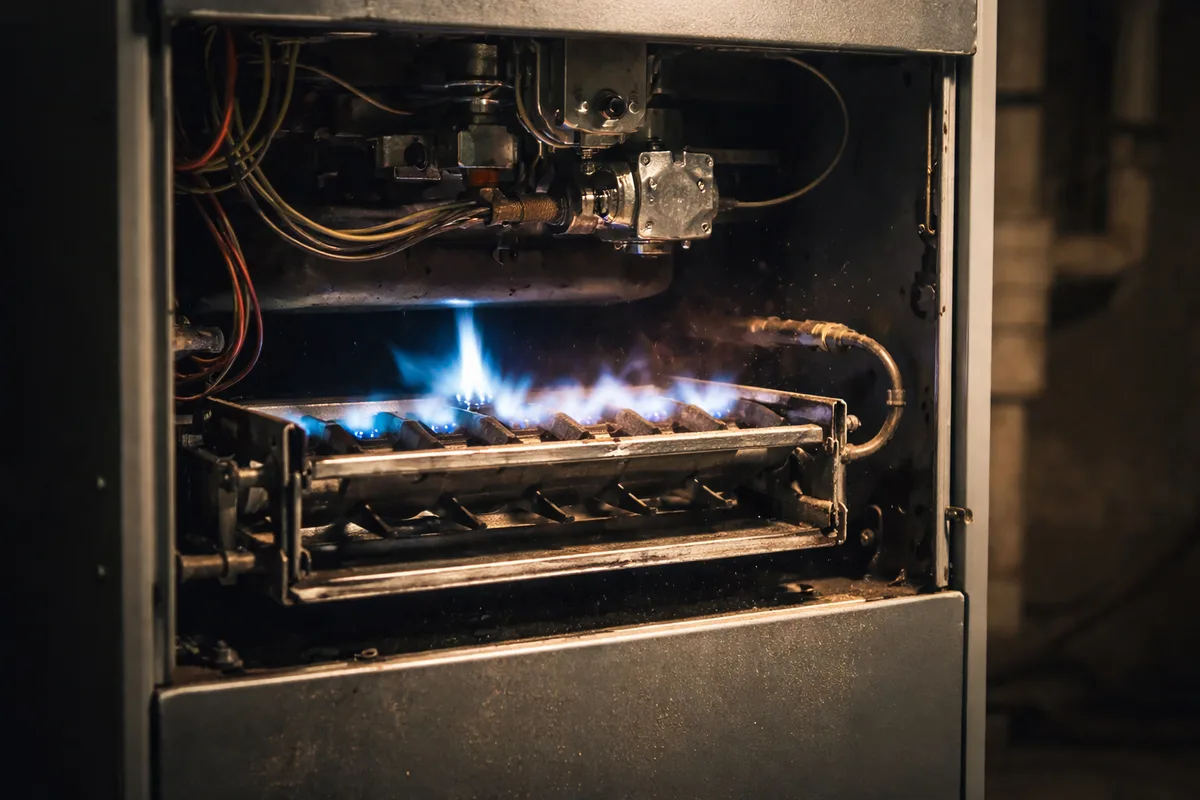
Fuel-burning central heat systems and water heaters can produce CO if burners are misadjusted, heat exchangers are damaged, or venting/chimneys are blocked. If you suspect a problem, stop using the appliance and arrange a professional inspection.
Signs that a furnace or water heater may be producing CO include a yellow or orange flame instead of a steady blue one, soot or discoloration around the unit or vent connections, a pilot light that repeatedly goes out, or unusual smells when the unit is running. If a water heater vent pipe feels hot to the touch or shows signs of corrosion, that may indicate venting problems. Carbon monoxide from furnace issues is one of the most common sources during heating season.
Stoves, Ovens, and Gas Ranges
Gas stoves and ovens can produce CO, especially if the flame is not burning correctly or ventilation is poor. Using a gas oven to heat a room is unsafe. Prioritize ventilation and proper appliance maintenance.
Watch for burner flames that are yellow or orange instead of blue, as this can indicate incomplete combustion. If the flame lifts away from the burner or goes out frequently, the appliance may need adjustment. Carbon monoxide from gas stove use increases when burners are clogged with food debris or when the kitchen lacks adequate ventilation, always use a range hood or open a window when cooking with gas.
Fireplaces, Wood Stoves, and Chimneys
Both wood-burning and gas fireplaces can be CO sources if the chimney flue is blocked, the damper is closed, or exhaust is back-drafting into the room. Soot, smoke smell, or poor draft are warning signs that require professional evaluation.
Warning signs include smoke entering the room instead of going up the chimney, a strong burning smell when the fireplace is in use, visible soot buildup around the fireplace opening, or difficulty starting a fire due to poor draft. If you notice any of these, stop using the fireplace and have a chimney sweep or qualified technician inspect the flue and damper.
Space Heaters and Unvented Heaters
Kerosene, propane, and other unvented or poorly vented heaters can create dangerous CO levels. Follow manufacturer instructions and never use fuel-burning heaters in unventilated rooms or while sleeping.
Clothes Dryers and Other Fuel-Burning Appliances
Gas dryers and other fuel-burning equipment can contribute to CO if exhaust is not properly vented outside.
Attached Garage and Vehicles
Running a vehicle in an attached garage, even with the garage door open, can allow exhaust to accumulate and infiltrate living areas. This includes "warming up" a car, idling near the garage, or operating gasoline-powered tools. Treat an attached garage as a high-risk zone and never idle a vehicle indoors.
More on vehicle scenarios: Carbon monoxide in your car.
Generators, Grills, and Outdoor Devices
Portable generators are a leading source of fatal CO poisonings during storms and power outages. Never operate a generator inside a home, garage, basement, crawlspace, or near open windows or doors. Use generators outdoors only, far away from buildings, with exhaust directed away.
Charcoal grills and fuel-burning camping devices can also produce deadly CO. Never use grills, camp stoves, or charcoal indoors (including tents, garages, or enclosed porches), even for a short time.
A common misconception is that using a grill or fuel-burning equipment outdoors is always safe. Grills placed on covered patios, under overhangs, or near open windows and doors can still send CO into living spaces, especially if wind pushes exhaust toward the building. Semi-enclosed areas like screened porches, carports, and breezeways can trap enough CO to create risk. Always position grills and outdoor fuel-burning equipment well away from any building opening, and never bring them closer during rain or bad weather.
The Law Has Read Your Furnace and Has Never Heard of Your Grill
Everything on this page is a source. Only some of them are sources the law recognises, and the split is sharper than you would guess. We searched all 51 US jurisdiction records, statutes, adopted codes and our own notes together, for the appliances people are actually poisoned by. Furnaces, fireplaces, boilers, water heaters and ranges appear across the corpus constantly, because that is what a carbon monoxide requirement is built around: a heated building with combustion plumbed into it.
Now the other half. The word "charcoal" appears in none of the 51 records. Neither does "barbecue", "barbeque", "hibachi" or "briquette". Neither does "boat", "vessel", "watercraft" or "marina". Neither does "camp stove" or "lantern". Not one jurisdiction in the fifty-one names any of them. And the pool heater, which a peer-reviewed case series identifies as the deadliest single hotel carbon monoxide source in the United States, causing 28 of 115 documented hotel incidents and 12 of the 22 deaths between 2005 and 2018, is named in no statute at all. Where it is reached, it is reached silently, as one more fuel-burning appliance under a general trigger.
That is not an oversight so much as a boundary. A carbon monoxide statute attaches a duty to a building and to whoever owns it, so it can only see the sources that are bolted to the building. A grill on a covered patio, a charcoal tray carried into a tent, a houseboat cabin with the engine running at the swim platform: nobody owes you an alarm for any of them, in any state, and the exposure is identical. Every source in this section is one you have to protect yourself against, because no legislature has written a rule that reaches it. North Carolina, which lists its covered appliances more explicitly than any other state, is worth reading for what it does at the edge: its statute names space heaters, wall and ceiling heaters, ranges, ovens, stoves, furnaces, fireplaces, water heaters and clothes dryers, and then excludes candles and canned fuels by name. Even the most explicit list in the country draws its line at things that are part of the house.
Travel and Seasonal Scenarios
CO incidents also occur in rentals, hotels, cabins, RVs, boats, and older homes, especially during winter or after storms when heating systems run continuously or when generators are used. If you travel frequently, consider a portable CO alarm for extra protection and always locate CO alarms in the property upon arrival.
CO Is Not Only a Winter Problem
US guidance ties carbon monoxide to the heating season. That fits the furnace and the generator, and it leaves a gap that another country's fire service has documented. Poland's national fire service, Komenda Główna Państwowej Straży Pożarnej, tracks CO ("czad") call-outs year-round and runs public warnings aimed specifically at summer poisonings.
Two seasons of their figures now sit beside each other, which is what turns a statistic into a pattern. In summer 2025 Polish firefighters logged 723 CO interventions in June with 53 people poisoned, and 776 in July with 48 poisoned. In 2026 the service reported 5,521 CO interventions between 1 May and 5 August, with 327 poisoned and 6 deaths, of which the school-holiday period alone accounted for 1,547 interventions, 96 poisoned and 1 death. The windows are not identical, June and July against a holiday period starting in late June, so read them as two soundings of the same off-season rather than as a year-on-year change. A country that runs summer CO warnings is not doing it on the strength of one odd year.
One line in that 2026 report is the most useful thing in it for a reader here, and no US agency publishes its equivalent: most of the poisoning incidents were reported after a CO alarm that had already been installed went off. Not after somebody felt ill, and not after a neighbour noticed. The alarm found them. That is what a working alarm buys in the season when nobody expects to need one, and it is the argument for the alarm staying on the wall through the summer.
The appliance behind the summer cases is a gas flow water heater in a bathroom, and the mechanism travels. The fire service explains it as heat: sun warms roofs, chimneys and ventilation ducts through the day, and the warm stagnant air forms a cushion in the duct that stops exhaust leaving the building. Gases that would rise in January sit still in July and come back into the room. Any US home with an atmospheric-vent water heater in a small closed space has the same physics available to it. If your CO alarm has been in a drawer since March, this is the argument for putting it back on the wall.
Warning Signs a CO Source May Be Malfunctioning
CO itself has no warning odor, but some situations suggest a combustion or venting problem:
- Soot or staining around an appliance, vent, or fireplace.
- A pilot light that frequently goes out or a flame that looks unusual.
- Excess condensation on windows or walls near fuel-burning appliances.
- Stale or stuffy air when heaters or fireplaces are running.
- People or pets feeling sick at the same time, especially when indoors.
These signs are not definitive, but they justify caution and professional inspection, especially if a CO alarm has sounded or symptoms are present.
To narrow down which appliance may be the problem: for furnaces and boilers, listen for unusual cycling patterns (turning on and off frequently) and check the area around the unit for soot or a burning smell. For water heaters, look at the vent pipe connections, gaps, rust or disconnections let exhaust spill into the room instead of leaving the building. For fireplaces, hold a lit match near the damper opening when cold, if the smoke drifts into the room instead of up the chimney, you may have a draft or blockage issue. In every case, a qualified technician with calibrated equipment should confirm and resolve the problem.
What to Do If You Suspect a CO Source
If your CO alarm sounds or you notice warning signs near a fuel-burning appliance, leave the building to fresh air first and call for professional guidance. Stop using the suspected appliance if it is safe to do so, but do not attempt DIY repairs on combustion equipment.
After the immediate risk is addressed, arrange a qualified inspection of the appliance and venting before using it again.
Which trade you call depends on the source, and calling the wrong one costs a visit fee and a week. This is keyed to the same seven sources as the reference table below.
| Source | What sends you there | Who to call |
|---|---|---|
| Furnace / Boiler | Short cycling, soot around the cabinet, a burning smell when it fires | HVAC technician with a combustion analyser, and ask for the analyser by name |
| Water Heater | Rust or a visible gap where the vent pipe meets the hood, condensation running down the flue | Licensed plumber; gas fitter where your state licenses the two separately |
| Gas Stove / Oven | Yellow or lifting flames, soot on the pan bottoms | Appliance service technician for the burner; the utility first if you can smell gas |
| Fireplace / Wood Stove | Smoke drifting into the room, a damper that will not seat, no draft when cold | Certified chimney sweep, not a general handyman |
| Any of the above, with a gas smell | The rotten-egg odorant, which belongs to the gas rather than to the CO | Your gas utility, from outside the building, before anyone else |
| Portable Generator | Exhaust reaching a door, window, vent or the neighbour's wall | Nobody. This one is repositioning, and no trade can make an indoor placement safe |
| Vehicle in Garage | Exhaust smell in the room over or beside the garage | Mechanic for the exhaust and body seals; builder for the garage-to-house sealing |
The generator row is the one worth reading twice. Every other line on this page ends with a professional; that one ends with moving the machine, because distance is the whole control and there is no service call that substitutes for it.
Emergency response steps: What to do if you suspect a carbon monoxide leak. Detection guide: How to detect a carbon monoxide leak. Prevention checklist.
Quick Source Reference
| Source | Risk Pattern | Key Prevention Step |
|---|---|---|
| Furnace / Boiler | Cracked heat exchanger, blocked vent | Annual professional inspection |
| Water Heater | Faulty venting, backdraft | Check vent connections yearly |
| Gas Stove / Oven | Misadjusted burner, poor ventilation | Use range hood; never heat a room with oven |
| Fireplace / Wood Stove | Blocked flue, closed damper, poor draft | Annual chimney inspection and cleaning |
| Portable Generator | Used indoors or near openings | Outdoors only, 20+ feet from building |
| Vehicle in Garage | Idling in attached garage | Never idle indoors; open garage door fully before starting |
| Space Heater | Unvented or used in closed room | Follow manufacturer instructions; ensure ventilation |
Sources & References
- US CPSC, Carbon Monoxide Information Center
- CDC, Carbon Monoxide Poisoning
- US EPA, Carbon Monoxide's Impact on Indoor Air Quality
- US CPSC, Generator Safety
- NFPA, Carbon Monoxide Safety
- CPSC, Safety Standard for Portable Generators, supplemental notice of proposed rulemaking, 88 FR, 20 April 2023, for the 2004-2021 death and injury counts
- KG PSP (Komenda Główna Państwowej Straży Pożarnej, Polish national fire service), "Uwaga na zatrucia tlenkiem węgla latem", in Polish: the summer poisoning mechanism, the 1 May to 5 August 2026 national figures, and the statement that most incidents were reported after an already-installed CO alarm activated
- KW PSP Poznań, "Najwięcej zatruć tlenkiem węgla... Latem?", in Polish: the June and July 2025 national intervention figures
Frequently Asked Questions
What are the most common sources of carbon monoxide in a house?
Fuel-burning appliances and engines are common sources: furnaces/boilers, water heaters, gas stoves/ovens, fireplaces, space heaters, generators, and vehicle exhaust from attached garages.
Can a gas stove cause carbon monoxide poisoning?
It can contribute to CO, especially if the flame is not burning properly or ventilation is poor. Proper maintenance and ventilation are important, and never use a gas oven to heat a room.
Can carbon monoxide come from a fireplace?
Yes. If venting is blocked, the damper is closed, or draft is poor, exhaust can enter the room. A professional inspection is recommended if you suspect back-drafting.
Where should a generator be used to avoid CO buildup?
Outdoors only, far from buildings, with exhaust directed away. Never use a generator in a garage or near doors, windows, or vents.
Can a single appliance produce enough CO to be dangerous?
Yes. A malfunctioning furnace, blocked water heater vent, or misused generator can each produce dangerous levels on its own, especially in a confined or poorly ventilated space.
Last updated: August 12, 2026