
Where to Place a Carbon Monoxide Detector
You installed a CO alarm last winter after reading about a family who narrowly escaped poisoning, but you mounted it in the kitchen, and now it chirps every time you cook. Meanwhile, the bedrooms down the hall have no coverage at all. If you are searching "where to place a carbon monoxide detector," you are already doing the right thing: CO safety is mostly about coverage and placement. A great alarm in the wrong spot can miss the exposure that matters most, when people are asleep, or it can trigger constant nuisance alerts and get ignored. Below are simple rules that cover most homes, room-by-room guidance, common placement mistakes, and a practical testing routine.
This is general safety information, not medical advice. If a CO alarm sounds or you suspect exposure, move to fresh air and contact emergency services.
Key Takeaways
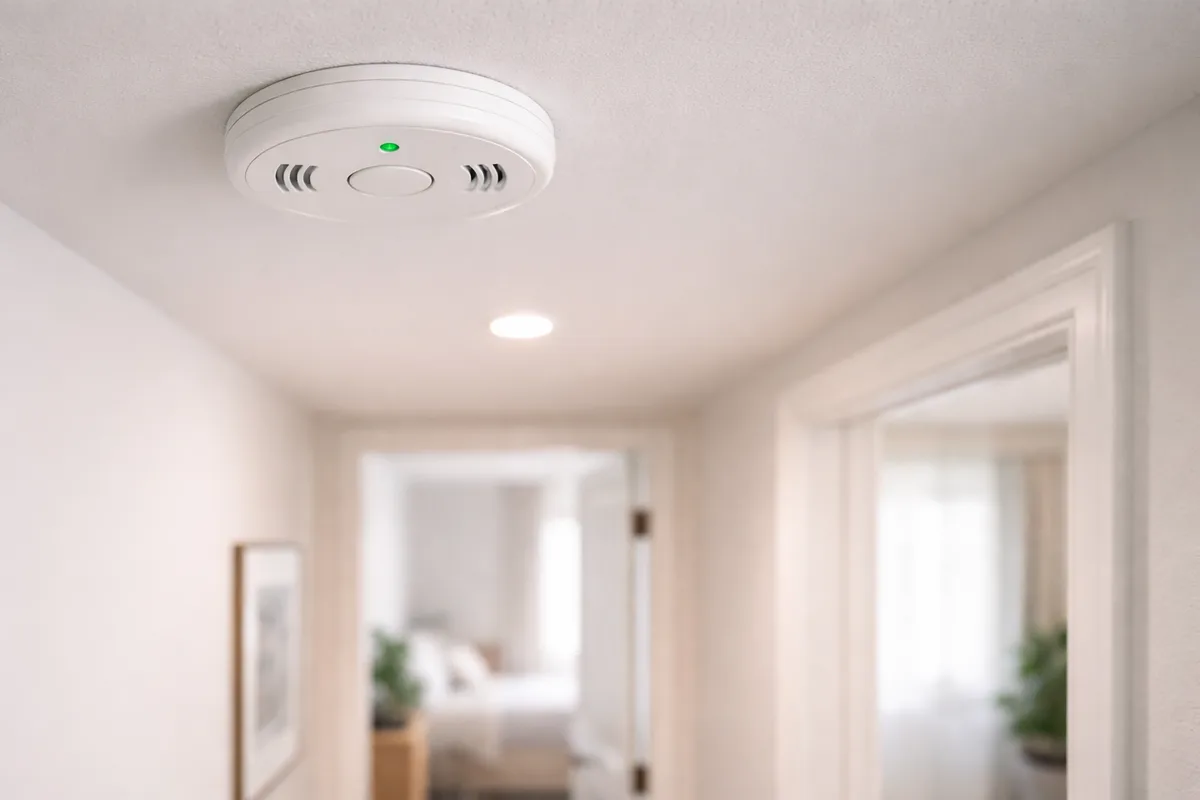
- Place a CO alarm outside each sleeping area, a hallway near bedrooms is the highest-value location.
- Cover every occupied level of your home, including finished basements and rooms above attached garages.
- Avoid kitchens, bathrooms, and drafty spots, these cause nuisance alarms that teach people to ignore the sound.
- Distance rules vary by state. NFPA 72 allows 21 feet from a sleeping room door and measures it along the path of travel, not through the wall; Florida and New Jersey require 10. Check your own before an inspection does.
- A fuel-burning appliance in a bedroom changes the rule, and six states write the in-bedroom alarm into their own instrument rather than leaving it to the model code: Arkansas, Iowa, Nevada, North Carolina, North Dakota and Ohio.
CO Detector Placement Check 2 min
Walk through your home layout and get a personalized placement plan based on your rooms, levels, and risk areas.
Core Placement Rules That Work in Most Homes
- Put a CO alarm outside each sleeping area. A hallway outside bedrooms is the classic "must have" spot.
- Put a CO alarm on every level you live on. If a floor is used daily (including a finished or used basement), it deserves coverage.
- Keep it audible at night. If bedroom doors are often closed, consider a unit in or near the bedroom so the alarm can wake sleepers.
- Follow the manufacturer instructions. CO alarms differ (battery, plug-in, hardwired; wall vs ceiling). Local codes can add requirements.
Not sure how many devices your layout needs? See how many carbon monoxide detectors do I need for a layout-based answer. For broader prevention steps beyond detector placement, see prevention of carbon monoxide poisoning.
How Far From the Bedroom Door?
"Outside the sleeping area" sounds precise until you stand in a long hallway and have to pick a stud. There is a number, and it varies more than most guides admit.
The national reference point is the wider of the figures in circulation. NFPA 72 Chapter 29, which absorbed the CO alarm requirements when NFPA 720 was folded into it, places the alarm outside each separate sleeping area within 21 feet of any door to a sleeping room, measured along the path of travel rather than in a straight line through the wall. State law frequently sets a tighter number, and the range across our 51-jurisdiction law reference is wide:
| Rule | Distance from the sleeping room | Citation |
|---|---|---|
| NFPA 72, Chapter 29 | 21 feet to a sleeping-room door, measured along the path of travel | Section 29.7.1.1 |
| Wisconsin (lodging) | 21 feet, measured along the path of travel | ATCP 72.18(12), effective January 25, 2026 |
| Illinois | 15 feet from every room used for sleeping | 430 ILCS 135 |
| Colorado (new construction) | 15 feet from the bedroom entrance | CCR Section R315 |
| Florida (covered new construction) | 10 feet from each room used for sleeping | Fla. Stat. Section 553.885 |
| New Jersey | 10 feet of sleeping areas | N.J.A.C. 5:1-28.1 |
Two things follow from that spread. Ten feet gets quoted online as though it were the national rule; it is a state figure, and less than half the distance the model standard allows. And if you are placing an alarm to satisfy an inspector rather than to satisfy yourself, the number that binds you is your own state's, not the one at the top of a search result. Wisconsin's phrasing is the one worth borrowing regardless of where you live: measure along the path of travel, the route sound and air take to reach the door, rather than straight through the wall.
One distance still in wide circulation has no source behind it. Guides describing Chicago quote 40 feet from every sleeping room, a figure that would leave the city looser than the 15 feet Illinois requires statewide. The chapter that carried it is gone: the City Council repealed the whole of Municipal Code Chapter 13-64 on 10 April 2019, and American Legal's current edition, 2026 S-73, prints that chapter as RESERVED above an editor's note recording the repeal. What governs new Chicago buildings now is Section 14B-9-915, enacted by the same 2019 ordinance, and it names no distance at all. It asks for detection outside each separate sleeping area in the immediate vicinity of the bedrooms, and inside any bedroom holding a fuel-burning appliance. A Chicago reader measuring 40 feet is working from a chapter that stopped existing seven years ago.
When the Alarm Belongs Inside the Bedroom
The hallway rule has an exception that catches people out, and six of the 51 US jurisdictions write it into their own instrument in those words rather than leaving it to preference or to the model code: Arkansas, Iowa, Nevada, North Carolina, North Dakota and Ohio. Where a fuel-burning appliance sits inside a bedroom, or inside a bathroom attached to that bedroom, the alarm goes in the bedroom itself.
New Hampshire gets there by a route worth understanding, because it is the one most summaries describe wrongly. RSA 153:10-a states no location at all. It requires the devices and then names a standard, "in accordance with the NFPA 720 Standard for the Installation of Carbon Monoxide (CO) Detection and Warning Equipment", so every New Hampshire placement rule comes from that standard rather than from the statute. NFPA withdrew NFPA 720 in August 2018 and moved carbon monoxide alarms into Chapter 29 of NFPA 72; the statute was last amended in 2011 and still names the withdrawn one. Fire departments in the state cite the successor, and Portsmouth gives the rule as NFPA 72 29.7.1.1, on every occupiable level of a dwelling unit including basements and excluding attics and crawl spaces, with the in-bedroom trigger where the room or its attached bathroom holds a fuel-burning appliance. States working from IBC 2021 reach the same place through Section 915.2.2, which requires detection inside a sleeping unit that contains a CO source and inside the bedroom specifically when the source is in that room or its attached bathroom.
The situations that trigger this are ordinary: a gas fireplace in a main bedroom, a wall-mounted gas heater in an older bedroom, a tankless water heater in an ensuite. If any of those describes your home, the hallway unit is not enough, whatever the distance rule says.
House vs Apartment: What Changes
Single-family houses
Houses usually have more potential CO sources: furnaces, boilers, water heaters, fireplaces, attached garages, and sometimes portable generators during outages. That means placement should prioritize sleeping areas, the level with fuel-burning equipment, and the path between an attached garage and the living space.
Apartments and condos
Apartments often have fewer on-site combustion sources, but CO risk can still come from gas stoves, shared building systems, or vehicle exhaust entering from attached garages or loading areas. The placement goal stays the same: protect sleep (outside sleeping areas) and cover your occupied levels. If your unit has gas appliances inside, treat it like a small house. For apartment-specific steps during an incident, see CO leak in an apartment.
Rooms to Prioritize
1. Outside bedrooms (hallway near the sleeping area)
This is the highest-value location because it protects the most vulnerable time: sleep. Place the alarm where it can be heard clearly from bedrooms. In long hallways, split-level layouts, or if bedrooms are far apart, you may need more than one unit to stay audible.
2. Bedrooms (when audibility is a concern)
Some homes benefit from a unit inside bedrooms, for example, if doors are closed at night, people use fans or white noise, or the hallway unit is separated by stairs or thick doors. Avoid placing it where steam, aerosols, or drafts can cause nuisance behavior.
3. Main living area (especially open-plan spaces)
A central location on the main floor helps detect issues that start during daytime use: a malfunctioning appliance, a blocked flue, or vehicle exhaust infiltration. If you spend most of your day on one floor, that floor should have a clearly audible unit.
4. Basements and lower levels in daily use
If your basement is finished, contains a bedroom, has a furnace or boiler area, or serves as a family room, place a unit on that level. Even for unoccupied basements, many homeowners add coverage on each livable level for simplicity.
5. Near the door from an attached garage
Attached garages are a common pathway for exhaust-related CO exposure, even brief car idling in an attached garage can push CO into the living space. Place a unit inside the home near the door leading to the garage, and consider coverage in rooms directly above the garage if they are used for sleep or daily living.
Common Placement Mistakes
| Mistake | Why It's a Problem | Better Alternative |
|---|---|---|
| Mounting in the kitchen | Cooking byproducts, heat, and humidity trigger nuisance alarms | Place outside the kitchen area, not over the stove |
| Inside the bathroom | Steam and humidity interfere with sensors | Hallway outside the bathroom |
| Dead-air corners near the ceiling | Poor air circulation reduces sensor accuracy | Open wall space with normal airflow |
| Next to vents, fans, or windows | Drafts dilute air around the sensor | At least 5 feet from drafty openings |
| Directly beside fuel-burning appliances | Localized plumes cause false readings | Same room but at recommended distance per manual |
| In the garage itself | Extreme temperatures and exhaust damage sensors | Inside the home near the garage door |
How to Reduce Nuisance Alarms Without Reducing Safety
Nuisance alarms are dangerous because they teach people to ignore the sound. If your unit chirps or alarms often, adjust placement before you "learn to live with it."
- Move it away from kitchens and bathrooms and out of direct drafts (vents, fans, windows).
- Keep it in a stable-temperature area rather than right beside a heat source or fireplace opening.
- Clean the alarm's vents (dust can affect sensing). Use the maintenance method recommended by the manufacturer.
- Give the appliance room. An alarm parked against a burner reads the appliance instead of the room, and normal start-up behaviour sets it off. Kidde's placement guidance says at least 15 feet; the manuals packed with individual models say 1 to 3 metres. Follow the manual that came in the box, because it is the one written for the sensor you own. One state writes a minimum into a rule rather than leaving it to the manual: Missouri's lodging rule at 19 CSR 20-3 says a detector must not sit within five feet of a gas-fuelled appliance, or near cooking or bathing areas. The physics does not change between a hotel room and a kitchen, so treat five feet as the floor and the manual's figure as the target. That 15 also collides with a statutory 15 that runs the other way, which is set out on how many detectors you need.
- Understand the difference between "beeping" and "end-of-life chirps." Many units chirp when the sensor reaches end-of-life. See carbon monoxide detector beeping for quick decoding.
Chasing nuisance activations is worth the effort for a reason that outlives the annoyance. A household that has learned to treat the sound as background noise has lost the alarm's whole function, and the moment that matters is usually the one where everybody is asleep.
Testing and Maintenance Routine
- Test the alarm regularly using the test button (and any other manufacturer-recommended method).
- Replace batteries on schedule (or immediately if you hear low-battery chirps).
- Replace the entire unit at end-of-life. Most CO alarms have a defined sensor life. See how long do carbon monoxide detectors last.
- Review placement after renovations, new doors, new HVAC registers, or remodeled kitchens can change airflow and affect performance.
Mounting Height: Wall vs Ceiling
Height turns out to be the least decisive part of this whole exercise. A sealed-chamber test published in The Journal of Emergency Medicine (online 2011) released CO at three different heights in an eight-foot chamber and found the concentration equalised from floor to ceiling every time, with no layer to aim at. Kidde permits any point on a wall from six inches below the ceiling to six inches above the floor. Mount the alarm the way your model instructs, keep it out of corners and dead-air pockets, and spend the attention you saved on which rooms you covered. Our guide to carbon monoxide detector placement height sets out what each manufacturer, the EPA and the European code of practice specify, and where building code takes the decision out of your hands.
If Your CO Alarm Goes Off
Treat any CO alarm activation seriously. Move everyone (including pets) to fresh air, then call emergency services from outside. Do not re-enter until responders confirm the building is safe.
Step-by-step checklist: What to do if a carbon monoxide detector goes off.
Frequently Asked Questions
Do I need a CO detector on every floor?
For most homes, yes, at least on every occupied level. This gives you coverage if CO accumulates on a different floor than the sleeping area and reduces blind spots in split-level layouts.
Where should I put a CO detector if I only have one?
Put it outside the sleeping area (the hallway near bedrooms) and make sure it is loud enough to wake you. If your home has a single level and bedrooms are close together, this single placement offers the best protection per device.
Should I place it in the bedroom or hallway?
Start with the hallway outside bedrooms. Add bedroom units when doors are closed at night, people use loud fans or white noise, or the hallway unit is not reliably audible in every bedroom.
Should I put a CO detector in the garage?
Typically, no. Garages create harsh conditions (temperature swings, exhaust, dust) that can damage or confuse sensors. Instead, place a unit inside the home near the door leading to the attached garage.
Can smoke alarms detect carbon monoxide?
Smoke alarms are for smoke and fire, not CO. You need a dedicated CO alarm or a combination smoke/CO unit specifically rated for both hazards.
Sources & References
- EPA: Where Should I Place a Carbon Monoxide Detector?
- CPSC: Carbon Monoxide Information Center
- CDC: Carbon Monoxide Poisoning Prevention
- NFPA: Carbon Monoxide Safety
- Can Carbon Monoxide Detectors Be Influenced by CO's Weight Relative to Air? The Journal of Emergency Medicine, 2011. doi:10.1016/j.jemermed.2011.03.015. The sealed-chamber test the mounting-height section rests on.
The Instruments Behind the Distance Table
Given as plain text rather than links, because these are the documents the numbers come from and several of them sit behind paywalls or subscription code services. Each is quoted on this page for its distance rule only.
- NFPA 72, National Fire Alarm and Signaling Code, Section 29.7.1.1, for the 21-foot allowance measured along the path of travel.
- Wisconsin Administrative Code ATCP 72.18(12), effective 25 January 2026, which adopts the same 21-foot wording for lodging.
- 430 ILCS 135, the Illinois Carbon Monoxide Alarm Detector Act, for 15 feet from every room used for sleeping.
- Code of Colorado Regulations, Section R315, for 15 feet from the bedroom entrance in new construction.
- Florida Statutes Section 553.885, for 10 feet from each room used for sleeping in covered new construction.
- New Jersey Administrative Code N.J.A.C. 5:1-28.1, for 10 feet of sleeping areas.
- New Hampshire RSA 153:10-a, for the statute naming NFPA 720 rather than stating a location, and for the delegation that puts every New Hampshire placement rule in the standard.
- American Legal Publishing, Chicago Municipal Code, current edition S-73, which prints Chapter 13-64 as RESERVED with an editor's note recording the repeal of 10 April 2019, and carries Section 14B-9-915 as the provision that replaced it.
- Hampson NB and colleagues, "Should the Placement of Carbon Monoxide (CO) Detectors be Influenced by CO's Weight Relative to Air?", The Journal of Emergency Medicine, published online 2011, doi:10.1016/j.jemermed.2011.03.015. The sealed-chamber experiment behind the height finding: CO released at the top, middle and bottom of an eight-foot chamber equalised throughout in every trial.
- Kidde, alarm placement guidance and the installation manual supplied with each model, for the clearance from fuel-burning appliances. The two do not agree with each other, which is why this page says to follow the manual that came in the box.
Last updated: August 12, 2026