
What to Do If You Suspect a Carbon Monoxide Leak
Your carbon monoxide alarm is going off, or multiple people in the house feel dizzy and nauseous at the same time. The instinct to investigate can be strong, but it's the wrong move: CO levels can rise quickly and you cannot judge safety by how you feel. Whether you're dealing with a carbon monoxide leak in an apartment, a house, or a rental, the safest response is the same, get everyone out first, then call for help. This page provides a step-by-step checklist for what to do if you suspect a carbon monoxide (CO) leak, covers apartment-specific steps, and explains the medical red flags that require urgent care.
Emergency steps:
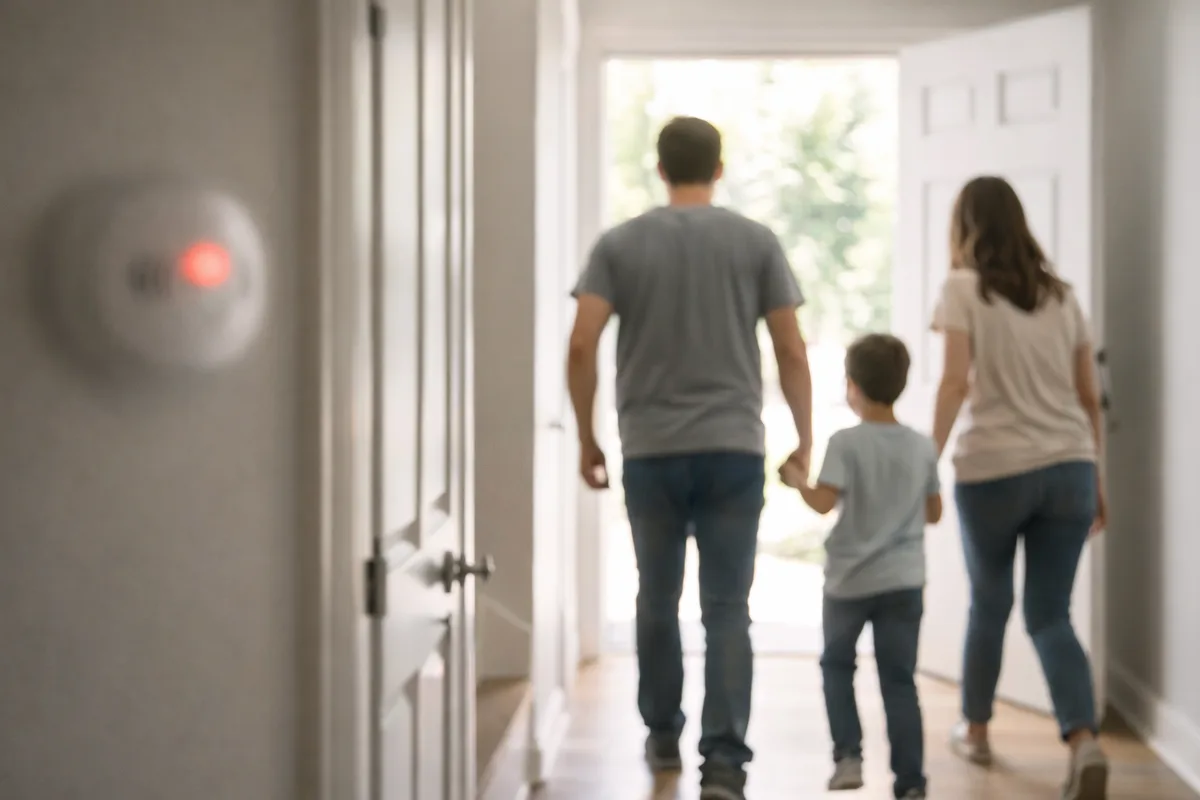
- Get everyone to fresh air immediately (including pets).
- Call emergency services / fire department for guidance and air testing.
- Do not re-enter the building until professionals confirm it's safe.
- If anyone is confused, fainted, has chest pain, or is struggling to breathe, treat as an emergency.
- Do not try to "find the leak" by staying inside or troubleshooting appliances.
- After the incident, have fuel-burning appliances and venting inspected by qualified professionals.
CO Symptoms Action Check 1 min
Not sure how serious the situation is? Answer a few questions about symptoms and alarm status to get clear guidance.
Three Things People Miss On the Way Out
The emergency box above is the sequence. These are the details that get dropped in the first minute and are worth deciding in advance:
- Account for everyone by name, out loud. Children, older adults, anyone who was asleep, and pets. CO affects judgment before people notice it, so counting heads is more reliable than assuming everyone heard the alarm.
- Open doors as you pass them, and only as you pass them. It costs nothing on the way out. Going back for a window costs the thing you are trying to protect.
- Tell responders if anyone was asleep, or if more than one person felt ill. Both change how they read the scene and how the medical side is handled, and neither is obvious to someone arriving after the fact.
What comes after clearance is set out under After the Incident further down.
Ventilation: What Helps vs. What Doesn't
A common first instinct when a carbon monoxide alarm goes off is to open windows and stay inside. It is a mistake with serious consequences. Opening windows may temporarily lower CO levels in the room, but it does not stop the source from producing more CO. If a furnace, water heater, or other appliance is continuously generating carbon monoxide, the levels can rise again as soon as ventilation changes, a door closes, wind shifts, or the appliance cycles on again. Meanwhile, you remain in the building exposed to a gas you cannot see or measure without professional equipment.
What helps when you suspect a CO leak: leave the building entirely and call for professional help from outside. Responders have calibrated meters that can detect CO levels throughout the building and pinpoint the source. Ventilation can be part of the remediation process, but only after evacuation and only under professional guidance. The key principle is always the same: people first, air testing second, source repair third.
Another misconception: running fans or turning on the HVAC system will "clear" the CO. In some cases, running the HVAC can spread CO from one part of the building to another, or the HVAC system itself may be the source. Do not attempt to troubleshoot appliances while you're still inside, leave that to qualified technicians with the right equipment.
If You Live in an Apartment or Rental
A carbon monoxide leak in an apartment can be more complex than in a house because CO may originate from shared mechanical rooms, boilers, or a neighbor's unit. Your safety steps don't change, but your follow-up should include the building.
- Follow the emergency checklist first, don't wait for the landlord or manager.
- Notify building management/landlord after you are safe; request a qualified inspection of shared equipment and venting.
- If you believe the problem may affect other units, inform neighbors and management (responders may advise broader evacuation).
- Document the incident (alarm photo/time, symptoms, responder report) for follow-up and maintenance tracking.
- If your landlord is unresponsive, contact your local fire department or housing authority for guidance on your rights and next steps.
That last call goes better with a citation behind it. Across the 51 US jurisdictions in our law dataset, 44 record a landlord duty that reaches a CO alarm, and the recurring pattern is a duty to provide working alarms and to repair or replace them once the tenant gives written notice. Not all of them name the alarm: a few states leave it to a general habitability clause, so check your own state page before citing a section. Written notice is the part tenants skip and the part that starts the clock, so send it by email or through the maintenance portal rather than mentioning it in a corridor. Our rental CO detector laws by state pages set out the wording and the duty split where you live.
The Notice, So You Do Not Have to Draft It Standing Outside
Telling somebody that written notice starts the clock and then leaving them to write it at eleven at night is most of the way to useless. Paste this into the maintenance portal or send it as an email, and change what needs changing:
Subject: Carbon monoxide alarm activation at [unit], [date]
The carbon monoxide alarm in [location, for example the hallway outside the two bedrooms] activated at approximately [time] on [date] and sounded for [duration]. [Emergency services attended and took readings / I evacuated and have not re-entered]. [Names] were in the unit at the time and reported [symptoms, or: nobody reported symptoms].
I am giving you written notice of a suspected carbon monoxide source in the unit and requesting inspection of all fuel-burning appliances and their venting by a qualified technician, together with inspection or replacement of the alarm itself. Please confirm in writing when the inspection is booked, and send me the technician's report and the readings taken.
I am treating this message as the date of notice for the purposes of your obligations as landlord.
Three things make it work. It is dated and in a system that records the date, which is the only thing the deadline can run from. It asks for the readings rather than for reassurance, so "we had someone look at it" does not close the matter. And the last line says out loud that the clock has started, which is the sentence a landlord's own records will be read against later. Where your state sets a repair window, name it in the second paragraph; the deadline for your jurisdiction is on its page in the rental hub.
Medical Red Flags: When to Seek Urgent Care
CO exposure can escalate from mild headache to a medical emergency. Seek urgent care if anyone shows these signs during or after a suspected leak:
- Confusion, inability to stay awake, fainting, or seizures.
- Chest pain, shortness of breath, palpitations, or severe weakness.
- Severe headache with vomiting or worsening neurological symptoms.
- Symptoms in a child, older adult, pregnant person, or someone with heart disease.
- Symptoms that improve outdoors but return indoors (possible ongoing exposure).
When calling emergency services, mention that CO exposure is suspected. This helps responders prioritize air testing and helps clinicians order appropriate blood tests rather than treating symptoms as a routine illness.
After the Incident: Verify the Source and Prevent Recurrence
Once responders have cleared the building, the work isn't over. Identifying and fixing the CO source is essential to prevent another incident.
- Have fuel-burning appliances inspected and serviced; ensure venting/chimney paths are clear.
- If you used a generator, confirm it was outdoors and far from doors/windows; never use it in a garage.
- Check CO alarm placement and age; replace alarms that are expired or unreliable.
- If symptoms persist or new symptoms develop days later, seek medical evaluation (delayed effects can occur).
Before You Go Back Inside
Before returning home after a CO incident, make sure these conditions have been met:
- A qualified professional has tested the entire home with a calibrated CO meter and confirmed levels are safe.
- The source of CO has been identified and either repaired, replaced, or shut down.
- If the source was an appliance, it has been serviced by a licensed technician and confirmed safe to operate.
- CO alarms are present and working on every level of the home and near sleeping areas.
- Ventilation paths (vents, flues, chimneys) have been checked and confirmed clear and properly connected.
- If the incident involved a generator, it has been repositioned outdoors, at least 20 feet from the building, with exhaust directed away from any openings.
Do not accept verbal reassurance without testing. CO levels can be measured quickly with professional equipment, and a responsible technician will confirm readings before clearing you to return. If you have any doubt, ask to see the meter readings yourself. Your safety depends on verifying that the source is fixed, rather than on the air seeming better for the moment.
Read next: How to detect a CO leak. Common sources of carbon monoxide.
Sources & References
- CDC, Carbon Monoxide Poisoning
- US CPSC, Carbon Monoxide Information Center
- American Red Cross, Carbon Monoxide Prevention
- NHS, Carbon Monoxide Poisoning
Frequently Asked Questions
What should I do if my carbon monoxide detector goes off?
Leave to fresh air immediately, call emergency services from outside, and do not re-enter until the building is cleared. Treat it as real until proven otherwise. The full sequence, including what responders do once they arrive and what they will ask you, is on what to do if your carbon monoxide detector goes off.
Should I open windows if I suspect carbon monoxide?
Ventilation can help, but it should never delay evacuation. Leave first, then follow responder guidance.
What if I think it's a false alarm?
If there's any doubt, prioritize safety: leave and call for guidance. Alarm patterns differ by device, and CO can be intermittent.
My alarm is chirping, is that the same as an alarm?
No. A chirp is usually low battery or end-of-life, and the interval tells you which, though manufacturers do not agree on the code. Our chirp pattern guide sets out what each brand means. If anyone has symptoms, or you cannot tell a chirp from an alarm, treat it as an alarm.
Should I call the fire department or 911 for a CO alarm?
Either is appropriate. Many fire departments respond to CO alarms and can test air levels. Call whichever number you reach first.
Should I try to find the CO source before leaving?
No. Leave first and let professionals investigate. Searching for the source delays evacuation and keeps you exposed to a gas you cannot see or smell.
When can we safely go back inside?
Only after professionals confirm the space is safe and the suspected source has been addressed.
Last updated: August 12, 2026